Travelling with a Parent Who Has Dementia: Planning, Flights and Safety
Published on:
Quick answer Travelling with a dementia patient can work, especially in the early to middle stages, with a short, familiar, low-stimulation trip, a companion who stays beside them at all times, and a green light from the treating doctor. Plan around their best time of day, carry ID and medicines in hand luggage, request airport assistance early, and be ready to turn back. Whether to fly, and anything about medicines, is a decision for their doctor.
You’re probably reading this because a wedding is coming up. Or because you live abroad and want Papa to see your new home. Or because the family has always gone to the hills in June and nobody wants to say the tradition has to stop.
Then the worry kicks in. What if she panics at the airport? What if he walks off in the hotel at 2 a.m.? What if the whole thing costs everyone a week of sleep and sets her back?
These are fair questions, and there isn’t one answer for every family. Some people with dementia travel well, particularly when the trip is simple and the person is comfortable. For others, staying home is the kinder choice. This post helps you work out which one applies to your parent, and how to do it carefully if you go.
If you want the wider picture on trips with older parents, our broader guide on travelling with parents covers it. This post stays with the extra planning dementia needs.
First, should you travel at all?
Start with the person, not the destination. Three things matter most: how far the dementia has progressed, how they’ve coped with change recently, and what their doctor says.
Talk to the treating doctor before you book anything. Ask specifically about fitness to fly or take a long road journey, how to manage medicines across time zones, and what to do if your parent becomes distressed. Please don’t give or change any tablet, including something “to keep them calm”, unless the doctor has prescribed it for the trip. That decision belongs to the doctor alone.
Here’s a rough way to think about it. It’s a conversation starter for you and the doctor, not a medical verdict.
| Situation | Leaning | Why |
|---|---|---|
| Early stage; copes well with outings; recognises family; sleeps reasonably | Go, with planning | Familiar people and a calm schedule often make short trips manageable |
| Middle stage; some confusion in new places; occasional evening restlessness | Wait, then decide with the doctor | A short, local, familiar trip may still work, but a long-haul journey is a bigger ask |
| Recent hospital stay, new medicines, a recent fall, or a sudden change in behaviour | Wait | Let things settle first |
| Frequent wandering, strong distress in new places, or needing hands-on help for most daily care | Probably don’t, unless the doctor agrees | The risk and the strain on your parent may outweigh the benefit |
| Advanced stage with significant physical frailty | Don’t travel for leisure; talk to the doctor about comfort-focused care | See our guide on palliative care |
A useful test: would this trip be for your parent, or mostly for the rest of the family? Both are valid reasons. But be honest about which one it is, because it changes what you’ll accept going wrong.
Choosing where to go, and for how long
The best trips for a person with dementia are boringly familiar.
- Pick known places. A relative’s home, a hill station they’ve visited for decades, or a short trip to a city they know well tends to be easier than a first-time destination.
- Keep it short. A long weekend is a very different thing from three weeks.
- Avoid long journeys with many changes. A direct flight beats one with a tight connection. Where possible, travel in the daytime.
- Stay near good healthcare. Check there’s a hospital and a pharmacy close to where you’ll be.
- Prefer a quiet base. One hotel for the whole stay, rather than moving every two days.
- Skip the packed itinerary. One outing a day, with long rests, is plenty.
Think about the time of year, too. Peak-season crowds and heat make everything harder for older people.
Keep the routine, even on the road
Routine is a kind of anchor. Wake-up, meals, tea, bath, bedtime: keep them as close to home timings as you can.
- Travel at the time of day when your parent is usually calmest. For many people that’s the morning.
- Carry familiar things: their own blanket or shawl, a favourite cup, a photo album, familiar music, the same brand of snacks.
- Use the same words and sequence you use at home for dressing and toileting.
- Build in a rest after every outing, even if they say they’re fine.
Safety kit: ID, tracking and medicines
Identification
Wandering can happen on any trip, because a new place can leave a person confused about where they are. Prepare as if it might.
- An ID bracelet with their name, your phone number and “memory loss” or “dementia”.
- A wallet card or card in a pocket with the same details, their address, allergies and doctor’s contact.
- A recent photo of your parent on your phone, and one printed in your bag. Taking a fresh photo each morning shows exactly what they’re wearing.
- A phone tracker or GPS device, if your parent will tolerate it. Think of it as a backup, not a substitute for being beside them.
- Ask your parent’s permission where you can, and explain it simply: “This is so we can always find each other.”
Medicines
- Keep all medicines in hand luggage, in original packaging, with a printed list of names and doses.
- Carry a doctor’s letter listing the diagnosis and prescription. Pack extra supply for a few days of delay.
- Ask the doctor how to handle dosing if you cross time zones. Don’t improvise this one.
- Use a pill organiser, and keep it in your own bag, not your parent’s.
Hydration and toileting
People with dementia may not say they’re thirsty or need the toilet. They may become restless instead.
- Offer water regularly, on a schedule rather than waiting to be asked.
- Suggest a toilet visit before leaving, before boarding, and every couple of hours.
- Carry a change of clothes and some discreet protection in your own bag. An accident isn’t a failure, and being prepared keeps it low-drama.
- Learn the signs: fidgeting, tugging at clothes, pacing.
Sundowning and unexpected triggers
Some people become more confused or agitated in the late afternoon and evening. It’s often called sundowning. If that’s your parent, plan around it. Don’t schedule flights, check-ins or big dinners in that window.
| What you notice | A gentle response |
|---|---|
| Restless pacing in the evening | Dim the lights, play familiar music, offer tea, keep voices low |
| Repeated “I want to go home” | Don’t argue. Say, “We’ll go soon. Tell me about home.” Walk together, then redirect |
| Refusing to move at the airport | Step aside from the crowd, wait quietly, offer a drink or snack |
| Not recognising the hotel room | Put a familiar photo and blanket out; use simple orientation like “this is our room” |
| Anger or accusations | Stay calm, don’t correct or debate; look for the cause such as hunger, noise or pain |
| Needing the toilet but not saying so | Offer a visit calmly, and don’t make it a big deal |
Airports, security and the flight
For a deeper look at what’s available, read the airline’s and airport’s own assistance pages before you travel. Here’s what generally helps.
Special assistance
- Tell the airline at booking that your parent has dementia, and ask what they need from you. Indian airlines are bound by DGCA rules on assistance for passengers with disability or reduced mobility, and passengers are generally asked to inform the airline at least 48 hours before departure. Please check the current rule and your airline’s process.
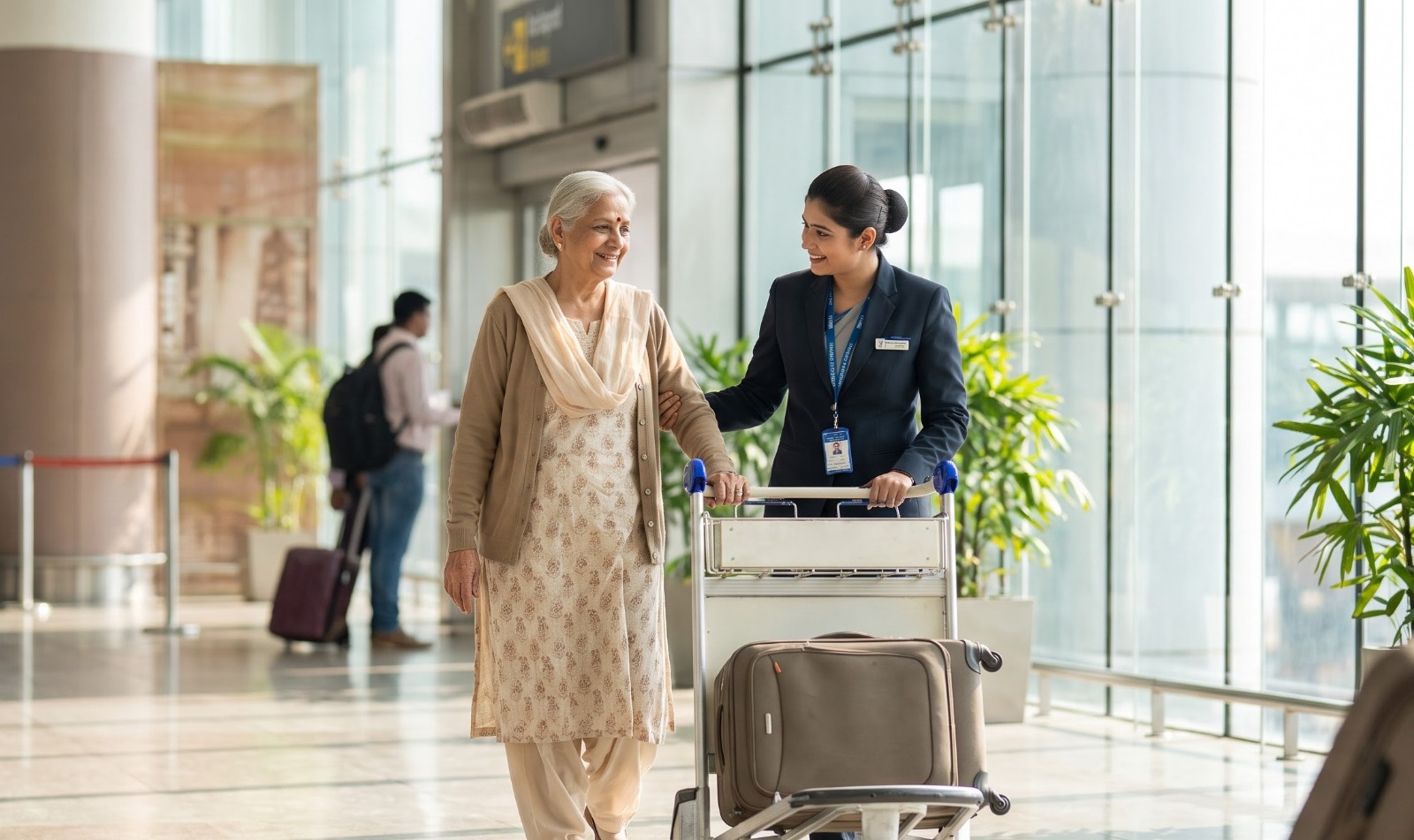
- Ask for wheelchair or buggy assistance even if your parent can walk. It shortens waiting and walking, and an escort stays with you through security.
- Book assistance for the return journey too.
- Confirm the arrangement again a day before.
Getting through the airport
- Arrive early, but not so early that they spend hours waiting. Use a quiet corner, a snack and something familiar to hold.
- Check in luggage first, then relax once you’re through security.
- Tell security staff calmly that your parent has memory loss, so they take it slowly.
- Keep your parent’s hand in yours, or an arm linked through yours. Don’t leave them alone at the toilet door or while you queue.
- If they’re anxious about the scanner, let them watch you go through first.
Seating and boarding
- Ask for seats together. An aisle seat can help if your parent tends to get up, and you sit by the window to keep them from the aisle, or the reverse depending on how they respond.
- Request early boarding so they’re not rushed down a crowded jet bridge.
- Keep snacks, water, a shawl and a distraction (music, a photo book, a simple activity) within reach.
- Explain what’s happening in short sentences as it happens. “We’re going to sit here. The plane will start to move soon.”
If your parent shows a lot of distress on past outings, talk to the doctor about whether flying is wise at all. Don’t try to manage it with anything you’ve not been told to use.
Hotel room set-up and wandering safety
Choose a hotel that is quiet, has a lift, and has a ground-floor or easily reached room if possible.
- Tell the front desk about your parent’s dementia and ask them to help if your parent is seen alone.
- Ask for a room away from stairwells, fire exits and the pool.
- Share a room, or at least connecting rooms, so you notice at night. If your parent sleeps lightly, a door chime or alarm on the door can alert you; you can buy simple ones.
- Place a night light between the bed and the bathroom, and keep the path clear. Our post on fall prevention has simple ideas that apply to hotel rooms too.
- Cover or turn away mirrors if your parent finds their reflection upsetting.
- Make the bathroom easy to find: leave the light on, door open.
- Put the hotel’s card in your parent’s pocket with the address and phone number.
- In a lobby or restaurant, sit where you can see the doors.
If you want help setting up the basics at home before and after the trip, how to take care of elderly at home is a practical place to start.
Talking to your parent about the trip
Too much advance notice can create weeks of worry. Too little can feel like a shock. Most families find it works to share the plan close to the day, in simple words, and repeat it calmly.
- Say what, who and when in one or two sentences: “On Saturday we’re going to Jaipur to see Meera. I’ll be with you the whole time.”
- Don’t give long explanations or ask them to remember details.
- Answer the same question again with the same warm tone.
- Don’t argue if they say “I’m not going”. Pause, try again later, perhaps with a different reason.
- During the trip, narrate gently and keep your face relaxed. They’re often reading your mood more than your words.
Signs to cut the trip short
Be willing to go home early. That’s good judgement, not failure.
- Distress that doesn’t settle after several hours, even with calm routines
- Not eating or drinking much for a day
- A fall, sudden new confusion, fever, or a visible change in how they are, which needs medical attention
- Repeated wandering attempts
- Not sleeping for more than a night or two in a row
- You feel unable to keep them safe
If you’re worried about their health, seek medical help locally and contact their doctor. Don’t wait for the trip to end.
Packing list
| Category | What to carry |
|---|---|
| Documents | Passport or ID, tickets, insurance papers, doctor’s letter, printed prescription, emergency contacts |
| Medicines | All prescribed medicines in hand luggage, pill organiser, list with doses, extra days of supply |
| Safety | ID bracelet, wallet card, recent photo, tracker if used, hotel address card |
| Comfort | Shawl, favourite cup, familiar snacks, music with headphones, photo album |
| Personal care | Change of clothes in your bag, wipes, spare protection if needed, spectacles and hearing aids with spares |
| Calming extras | A simple activity (sorting beads, a magazine, folding cloth), tissue, water bottle |
The day of travel
| Time | What to do |
|---|---|
| Night before | Pack together, check documents, set out clothes, early dinner |
| Morning | Familiar breakfast, medicines as advised by the doctor, toilet visit, hydration |
| Leaving home | Photo of what they’re wearing, ID on, calm voice, no rush |
| At the airport | Assistance desk, check-in, toilet visit, slow pace, quiet corner while waiting |
| Boarding | Early boarding, seat settled, water and snacks within reach |
| In flight | Toilet visit when you can, gentle conversation, no heavy meals |
| Arrival | Wait for assistance, don’t rush, head straight to the room |
| Evening | Dim light, familiar routine, early bed, check room for hazards |
Look after yourself too
You’ll be watching, planning and soothing for hours. You’ll be tired.
- Share the load. Two family members are better than one.
- Plan a short break each day, even 20 minutes, while someone else stays with your parent.
- Eat properly and sleep when you can.
- Lower your expectations. A calm, uneventful day is a win.
- Tell relatives in advance how to help, such as keeping the visit short, speaking one at a time, and not quizzing your parent.
Caregiving strain is real. Our piece on challenges families face may help you feel less alone.
How a Senocare CareManager can help
Some families can’t be there for every step, perhaps because they live abroad or work long hours. Senocare’s travel and tours service supports seniors with passport services, visa assistance, air, train and hotel booking, forex, car rental, driver on call, travel insurance and escorted tours, all coordinated by CareManagers. A CareManager can talk through your parent’s needs with you and help plan an escorted trip. Whether your parent is fit to travel is for their doctor to say.
You can also explore our care and travel packages or get in touch to talk things through.
FAQs
Often yes, especially in the early stages, but it depends on the person and their health. Airlines generally don’t require medical clearance for a stable condition, though some may ask. Speak to the treating doctor first, tell the airline at booking, and arrange assistance in advance.
Please don’t decide that yourself. Never give a sedative or change any medicine on your own. If you’re worried about distress during the journey, discuss it with the treating doctor well before the trip. They know your parent’s health and can advise on whether travelling is wise at all.
Stay within arm’s reach and never leave them alone, even in the toilet queue. Carry ID and a recent photo. If you lose sight of them, alert airport staff and security immediately and give them the photo and clothing details. Acting early matters.
It depends on distance and your parent. A direct flight can be shorter than a long drive, while a car allows frequent stops and fewer crowds. Choose whichever involves less waiting, fewer changes and easier toilet access. Ask the doctor if you’re unsure.
Keep it simple and near the day. Say where you’re going, who’s coming and that you’ll be with them. Repeat the answers kindly if they ask again. Avoid long explanations, and don’t argue if they resist; pause and try again.
If distress doesn’t settle, they stop eating or drinking, fall, develop fever or sudden new confusion, or you can’t keep them safe. Seek medical help locally and consult their doctor. Changing plans is sensible. A trip that goes home early is still a trip that put your parent first.